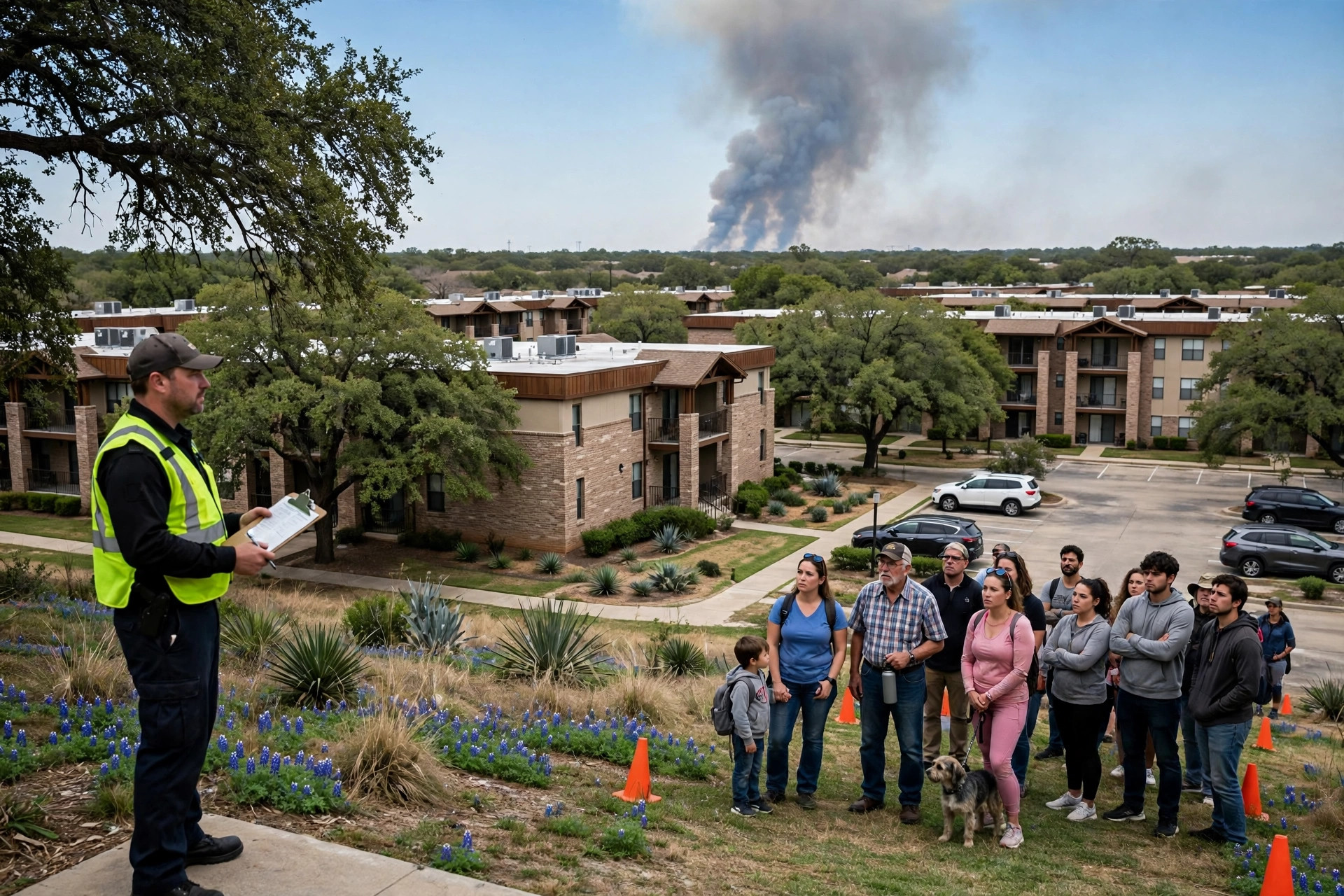
One verified incident per region, one lesson per incident. This launch edition of Watchful Eye, the Nationwide Fire Watch roundup, covers two Houston apartment fires, a New Orleans five alarm, a Tallahassee vacate order, 834 people displaced in Fort Worth, and a Chicago high-rise. One standing note applies to every edition: whether a fire watch is required is determined by your local fire code official, not by a headline.
Gulf Coast: Houston, Spring Branch and Meyerland
In Spring Branch, a three alarm fire on August 19 to 20, 2025 brought over 100 firefighters, displaced more than 300 residents, and left at least 90 homes with major damage. In Meyerland, a December 4, 2025 fire displaced around 40 residents, many of them older residents and wheelchair and oxygen users, and crews found no working hydrants in the interior courtyard and a broken street hydrant, forcing roughly 1,000 feet of hose to a working one. The fire department's position is that interior hydrants are the property owner's responsibility.
The manager's takeaway: suppression infrastructure fails at the street and at the riser, not only at the panel. Hydrant checks and impairment planning belong in the same file as your alarm service contract, which is why warehouse and apartment fire watch coverage in Houston starts with the building's water, not just its alarms.
Gulf Coast: New Orleans, Gentilly Ridge
On September 3, 2025, a five alarm fire at the fully occupied, 115 unit Gentilly Ridge Apartments in New Orleans spread quickly through a common attic space, damaging about 60 west side units and the laundry room. Twenty eight fire department units and 88 personnel responded, three civilians were treated, and one firefighter was treated for exhaustion. The cause is under investigation.
The takeaway: common attic space turns one unit's fire into a complex wide evacuation. Evacuation assistance for residents who cannot self evacuate is a staffing question to answer in the plan, not during the alarm.
Not sure where your property stands? Take the free fire watch assessment from Nationwide Fire Watch and see your gaps in plain language. Take the assessment, then book a 20 minute call at 1-800-294-5558.
Southeast: Tallahassee, the vacate order and the fatal fire
Tallahassee supplies this edition's hardest lesson, told in full in No Fire Watch, No Residents. One complex, Terra Lake Heights, could not secure a fire watch and was ordered emptied. Another, The Social Seminole, burned on November 19, 2025 with its alarm long failed, killing a student, even though a watch had been ordered and Building F was under one that night.
The takeaway: the watch is a bridge and a discipline. Secure it early, scope it in writing, and never let it substitute for the repair.
Texas: Fort Worth, The Cooper, and the weeks after the fire
The six alarm fire at The Cooper in Fort Worth on June 23 to 25, 2025 displaced 834 residents from a six story, 300 plus unit complex, burned for almost nine hours, and caused a partial collapse. The cause is unknown and believed possibly accidental.
The takeaway: the fire is hour one. The weeks after are engineers gating re-entry, residents retrieving belongings from a compromised building, and damaged systems waiting on restoration. Post fire buildings need controlled access and patrols until the official releases them, work that pairs post-fire fire watch coverage with apartment complex security services.
Midwest: Chicago, South Shore high-rise
On February 21, 2024, an extra alarm fire began in a second story kitchen of a 14 story South Shore apartment building in Chicago. Smoke filled the building, five children and two others were hospitalized, and one man was injured jumping from the fourth floor. The cause is under investigation.
The takeaway: in a high-rise, smoke is the evacuation problem, not flame. Corridor and stairwell discipline, and residents who know the plan before the alarm, decide outcomes that no response time can fix afterward. And when any system in that chain is impaired, the first call follows the sequence in Your Fire Alarm Panel Just Died at 2 A.M.
Frequently Asked Questions
What is the Watchful Eye fire roundup?
It is Nationwide Fire Watch's regional roundup series: one verified fire or life safety incident per region per edition, each with the allegation and confirmation status stated plainly and one practical takeaway for property and facility managers.
Does an incident in another state mean my Texas building needs a fire watch?
No. Whether a fire watch is required is determined by your local fire code official under your adopted code and the facts of your building. These editions teach patterns to plan around, not requirements.
What is the most common thread across these incidents?
Systems and infrastructure that were already impaired or unmaintained when the fire came: failed alarms, inoperable hydrants, and buildings whose plans assumed everything would work.
Take the free fire watch assessment from Nationwide Fire Watch today. It takes a few minutes, it shows exactly where you are exposed, and it gives you the checklist before an incident, an insurer, or a regulator asks for it. Take the assessment, then book a 20 minute call at 1-800-294-5558 and we will walk your results with you, line by line.